

How Japan’s Tourism Boom Is Fuelling the Rise of eSIM Technology in Global Travel
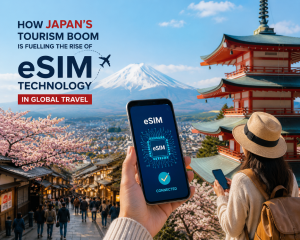
Japan welcomed more than 42 million visitors in 2025, a number that would have sounded absurd a decade ago. Somewhere between the record crowds at Shibuya crossing and the fully booked ryokans in Kyoto, a quieter story is playing out: staying connected the moment a plane touches down has become just as important to travelers as finding a hotel room. Airport counters that once sold physical SIM cards to jet-lagged tourists are being replaced by something faster — a Japan eSIM activated before the traveler even leaves home. It’s a small shift on the surface, but it reflects a much bigger change in how the travel industry treats connectivity.
Japan’s Tourism Numbers Are Breaking Records and Straining Infrastructure
The scale of Japan’s recovery from pandemic-era border closures is hard to overstate. After bottoming out in 2020 and 2021, inbound arrivals crossed 36.9 million in 2024, then jumped again to 42.7 million in 2025 surpassing 40 million for the first time in the country’s history. The Japan Tourism Agency is now chasing a target of 60 million annual visitors by 2030, and foreign visitor spending hit a record 9.5 trillion yen (roughly $60 billion) last year, second only to automobile exports as a source of foreign income.
What makes this growth notable isn’t just the total headcount, it’s how broad-based it has become. South Korea, Taiwan, and China remain the largest source markets, but arrivals from the U.S., Europe, and Australia rose by a combined 22% last year, and American visitor numbers alone passed 3 million for the first time. That diversification matters because it means Japan is no longer leaning on a handful of neighboring markets to hit its targets — it’s pulling in travelers from further away, with different expectations, different budgets, and different habits around how they get online while abroad.
Even political friction hasn’t slowed things down much. When diplomatic tension between Tokyo and Beijing led Chinese authorities to discourage travel to Japan in late 2025, arrivals from China still rose compared to the previous year, suggesting individual travel demand can outpace government messaging. Combined with strong bookings out of Europe and North America, this points to a tourism market that has become resilient enough to absorb shocks — but also one that is now large enough to expose every weak point in the country’s visitor-facing infrastructure.
Numbers like these don’t just fill hotel rooms. They put pressure on every layer of the tourism ecosystem:
● Airports such as Narita and Haneda are handling their busiest schedules since before the pandemic, with airlines adding routes and aircraft to keep pace.
● Labor shortages in hospitality and service have become a recurring headache, even as visitor spending climbs.
● Everyday infrastructure transit systems, payment networks, and mobile connectivity — is being asked to serve a visitor base far larger and more diverse than it was built for a decade ago.
Connectivity sits quietly inside that last category, and it’s easy to overlook. A tourist who can’t get online can’t use a map app, can’t translate a menu, can’t check a train schedule, and can’t book a last-minute reservation. As Japan’s visitor numbers climb toward that 60-million target, the country’s mobile networks and travel platforms are having to catch up fast.
Why eSIM Adoption Is Accelerating Everywhere, Not Just in Japan
The shift toward eSIM isn’t a Japan-specific trend; it’s part of a global move away from physical SIM cards that’s been building for several years. Most smartphones sold since around 2020 support eSIM, and the reasons travelers are switching have little to do with any one country’s tourism strategy.
A physical SIM card means hunting for a kiosk after a long flight, handing over a passport, waiting for activation, and hoping the tiny plastic chip doesn’t get lost between hotels. An eSIM profile can be purchased and installed before departure, activated the moment the plane lands, and removed without ever touching a piece of hardware. For a generation of travelers used to doing everything from their phone, that convenience is hard to ignore.
Handset makers have pushed this along too. Recent iPhone models sold in several markets ship without a physical SIM tray at all, and many Android flagships now default to eSIM-first setups. Add in the fact that a single phone can hold multiple eSIM profiles at once a home number alongside a travel data plan and it’s clear why adoption has climbed steadily across nearly every major travel market, not just Japan.
There’s also a cost and trust angle that shouldn’t be underestimated. Travelers who once relied on airport wifi or paid painful roaming rates now have a cheaper middle option that doesn’t require signing a contract or trusting an unfamiliar network’s security. Buying a data plan before a flight, rather than scrambling for one after landing, also removes a specific kind of stress that anyone who’s arrived somewhere at midnight with a dead phone battery and no local currency will recognize immediately. That single change of connectivity sorted before departure instead of after arrival is arguably the biggest behavioral shift eSIM has brought to how people travel.
Travel review sites and forums have picked up on this too, with eSIM comparisons now a standard part of pre-trip research alongside flight and hotel bookings. Where a few years ago travelers might have searched for “best pocket wifi Tokyo,” the search behavior has shifted toward eSIM providers and coverage maps, a small but telling sign of how quickly consumer habits move once the underlying technology becomes reliable enough to trust.
How Japan’s Telecoms and Travel Platforms Are Responding
Japan’s mobile carriers and travel booking platforms have moved quickly to meet this shift in visitor behavior. Rather than treating eSIM as a niche add-on, major providers now build it into the standard inbound-traveler journey, often bundling it alongside airport transfer bookings, pocket wifi rentals, or tourist SIM packages sold directly through airline and travel-agency websites.
This matters because it reflects adaptation at an industry level rather than a single company chasing a trend:
● Japanese mobile carriers have expanded eSIM offerings specifically aimed at short-term visitors, with data-only plans priced and structured around typical trip lengths.
● Travel platforms and airlines increasingly present eSIM options during the booking flow itself, rather than leaving connectivity as an afterthought handled at the airport.
● Convenience store chains and airport retailers, once the default source for tourist SIM cards, are now stocking eSIM QR-code vouchers alongside or instead of physical cards.
For a visitor arriving into Japan’s record-setting tourist crowds, that kind of pre-arranged connectivity removes one more friction point from a trip that already involves navigating a language barrier, an unfamiliar transit system, and, increasingly, long immigration lines.
What This Means for Other High-Tourism Destinations
Japan isn’t alone in this. Countries chasing similar visitor volumes Thailand, South Korea, the UAE, and several Southern European destinations among them are following comparable paths, with local carriers and tourism boards rolling out eSIM partnerships aimed squarely at inbound travelers.
The pattern tends to repeat itself: a destination sees inbound numbers climb past its previous ceiling, existing SIM-card infrastructure starts to show its age, and mobile operators respond by pushing eSIM as the default rather than the alternative. Where Japan differs slightly is in the sheer speed of its visitor growth combined with a mobile market that was already comfortable with digital-first services, which has made the transition happen faster than in some other high-volume destinations.
Where Travel Connectivity Is Headed Through 2027
Industry forecasts suggest this is still an early stage rather than a peak. As handset manufacturers continue phasing out physical SIM trays entirely in more markets, and as eSIM provisioning becomes standard within airline apps and travel booking platforms, connectivity is likely to shift from being something travelers arrange to something that’s simply included. Expect tighter integration between visa applications, airline check-in, and data plan activation over the next couple of years, with AI-assisted travel apps in markets like Japan already experimenting with bundling connectivity into broader itinerary planning tools, alongside crowd alerts and automated check-in features.
A few developments seem likely to shape this space through 2027:
● More airlines will fold a data plan option directly into ticket purchases, so travelers arrive with connectivity already switched on rather than needing to shop for it separately.
● Tourism boards in high-volume destinations will treat connectivity as part of national infrastructure planning, not just a service left entirely to private carriers.
● Multi-country eSIM plans covering an entire trip itinerary, rather than a single destination, are likely to become more common as regional travel patterns (such as combined trips across Japan, South Korea, and Southeast Asia) keep growing.
None of this suggests physical SIM cards will disappear overnight — plenty of budget travelers and older devices will still rely on them for years. But the direction is clear enough that most major carriers and travel platforms are now building for an eSIM-first future rather than treating it as a side option.

Connectivity Is Becoming Part of a Destination’s Competitiveness
Japan’s tourism boom didn’t create the eSIM trend, but it’s accelerating it in a visible way. As the country pushes toward 60 million annual visitors, staying connected from the moment of arrival is no longer a minor convenience; it’s becoming as central to a good trip as a visa-free entry policy or a direct flight route. Destinations that make connectivity effortless are giving themselves a real edge, and Japan’s telecoms and travel sector appear to understand that better than most.