

Cancer risk from full body scanners “extremely low”
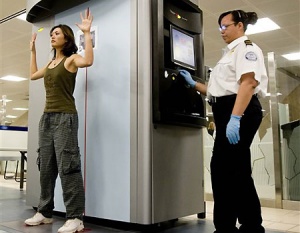
The potential health risks of airport full body screenings have been raised by a new report, highlighting the danger of cancer causing radiation.
According to a the Inter-Agency Committee on Radiation Safety report pregnant women and children should not be subject to scanning, even though the radiation dose from body scanners is “extremely small”.
The committee includes the European Commission, International Atomic Energy Agency, Nuclear Energy Agency and the World Health Organization.
A more accurate assessment about the health risks will not be possible until governments decide whether all passengers will be systematically scanned or randomly selected, the report added. It recommended that governments justify the additional risk posed to passengers, and should consider “other techniques to achieve the same end”.
The devices, which cost about 10 times as much as conventional airport scanners, are likely to go into much wider use since a Nigerian man with explosives hidden undetected in his underwear boarded a U.S. airplane heading to Detroit on Christmas Day.
ADVERTISEMENT
While normal annual background radiation per person runs to about 3,000 microsieverts - a unit used to measure radiation exposure - the body scan delivers 0.1 to 5 microsevierts, the report said.
“This (risk) is very small,” Renate Czarwinski, head of radiation safety and monitoring at the International Atomic Energy Agency (IAEA) in Vienna.
“Every application of X-ray systems should be justified. You have to weigh the benefits and the probable harm. The benefit, for security, is very high,” she said.
There are two types of full-body scanner - one which uses high frequency radio waves and one using X-rays - and only the latter machine would expose passengers to the ionizing radiation such as that used in medical X-rays, Czarwinski said.
Although the dosages are small, the inter-agency report said exposures should be carefully monitored.
“In order to appropriately assess the full radiological protection impact of scanner use, the manner in which passengers will be selected should be known,” it said.
The scanners, used to see under clothes and identify unusual objects, may have detected the hidden explosives the Nigerian is alleged to have carried on board the jetliner.