

Natural Selection Unveils Hoanib Elephant Camp: Where the Desert Elephants Roam
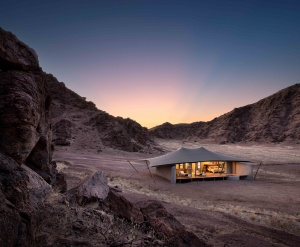
Natural Selection’s Hoanib Elephant Camp opened in May within Namibia’s remote Kaokoland, offering travelers access to one of Africa’s last truly wild places. Located in the country’s remote northwest, this rugged landscape is shaped by ancient river systems that flow only during seasonal rains. For much of the year, these dry riverbeds cut through towering mountains and expansive desert plains. It is one of the driest environments on Earth, yet life continues to thrive against all odds.
The Desert Elephants of the Hoanib River Valley
Among the region’s most remarkable inhabitants are the desert-adapted elephants. Found only in small populations across Namibia’s vast desert landscapes, they are among the world’s most unique elephant populations. Fewer than 50 elephants move through the Hoanib River system at any given time.
Over generations, these elephants have adapted to survive in one of the harshest environments on the planet. They travel extraordinary distances between water sources, with longer legs, broader feet, and an impressive ability to endure extreme desert conditions.
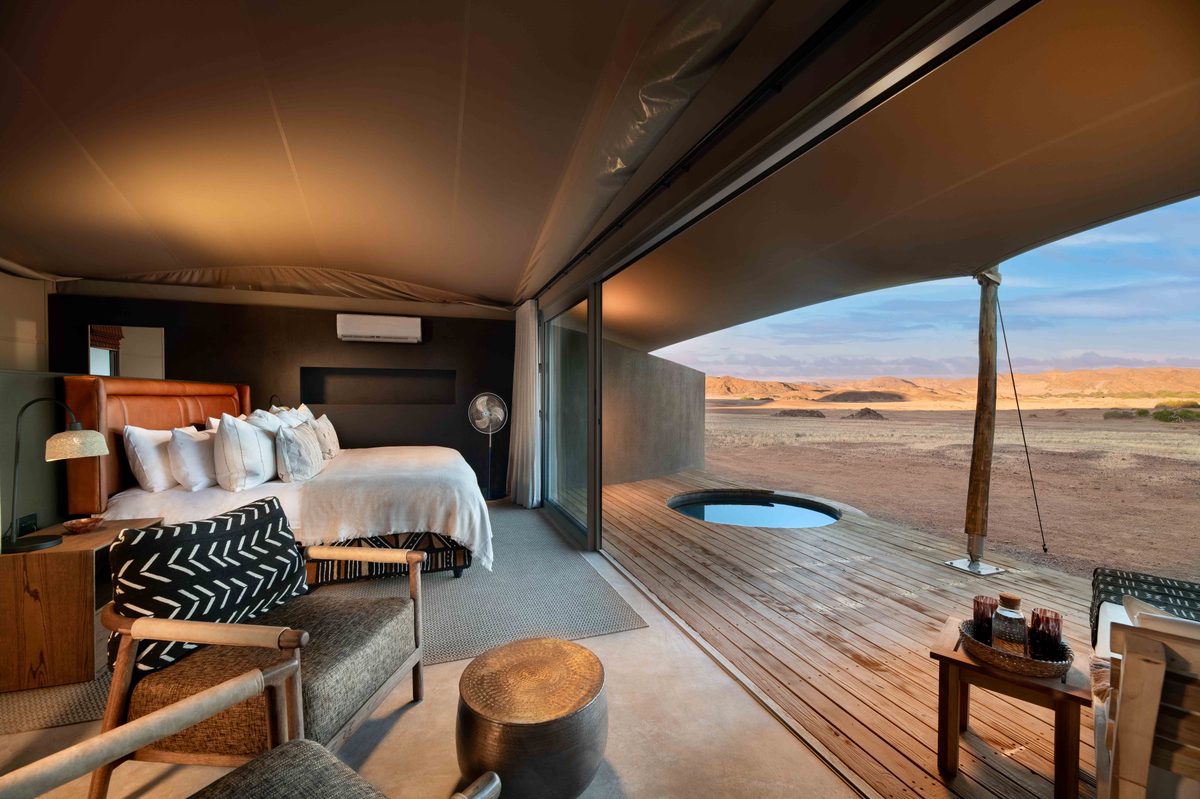
Hoanib Elephant Camp features just ten spacious guest suites, providing access to one of Namibia’s most remote and wildlife-rich landscapes. Here, guests watch desert elephants move through sunlit valleys beneath endless skies is one of Africa’s most extraordinary wildlife experiences. Guests don’t simply encounter these animals — they connect with the landscape that has shaped them.
ADVERTISEMENT
Where the Desert, Mountains, and Ocean Converge
The camp sits in a landscape formed over millions of years by tectonic activity, wind erosion, and the movement of the Hoanib River itself. Large ana trees line the banks of the seasonal riverbed, creating ribbons of green throughout the otherwise arid terrain. Their roots reach deep underground in search of water, providing shade and a critical food source for desert-adapted wildlife, including elephants, giraffe, and oryx. Beyond the riverbanks and gravel floodplains, rugged mountains rise across the horizon. To the west, the landscape eventually gives way to the Skeleton Coast, where desert and Atlantic Ocean converge in one of Africa’s most striking natural settings.
While the region’s desert wildlife attracts many travelers, it is ultimately the scale, stillness, and sense of place that define the experience. Days are spent exploring the landscape in search of desert-adapted elephants, giraffe, and the elusive desert lion, or tracking free-roaming black rhino alongside expert guides. Beyond its wildlife, the region is also home to the semi-nomadic Himba people, whose traditions and deep connection to the land have endured for generations.
Protecting the Future of the Desert Giants
Hoanib Elephant Camp partners with the Sesfontein Community Conservancy to support conservation initiatives throughout the Hoanib River Valley. Efforts include monitoring elephant movements, helping reduce human-wildlife conflict, and supporting sustainable opportunities for local communities.
Every stay at Hoanib Elephant Camp directly contributes to protecting these elephants and the ecosystem they depend on. A portion of each booking — 1.5% of every guest stay, in addition to the Community, Conservation and Reserve (CCR) fee — supports wildlife conservation, habitat preservation, and local community initiatives.