

AI shifts power in travel distribution from visibility to trust
Artificial Intelligence is shifting power in travel distribution away from visibility and toward trust, redefining how travelers discover, evaluate and book experiences.
Rather than eliminating intermediaries, AI is reshaping where value — and control — sits across the travel ecosystem. As travelers increasingly rely on AI assistants to plan trips, the industry is moving from a search-driven model to one where algorithms decide what gets seen — and what gets sold.
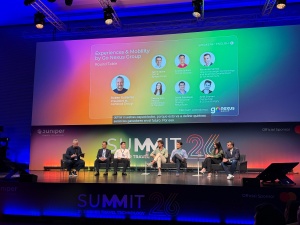
That shift was at the center of discussions during the panel “AI, Personalization & the Future of Distribution in Travel Experiences”, held at the Juniper Summit in the Palma Convention Center.
Moderated by Rubén Gutiérrez, the session brought together executives from Civitatis, TUI Musement, Juniper Group, NexusTours, Bridgify and Transferz.
AI becomes the new gatekeeper
ADVERTISEMENT
As AI intermediates the discovery process, traditional visibility is losing relevance. “It’s no longer about who appears first in search results, but about who AI trusts,” said Andrés Spitzer, CEO at Civitatis.
He noted that as AI increasingly mediates discovery and decision-making, companies must rethink how they make themselves “legible” to algorithms, while continuing to strengthen brand equity in parallel.
In this environment, companies must ensure their content is structured and accessible to AI systems, while simultaneously building strong brands and delivering consistently high-quality products. Without these elements, even the largest inventories risk becoming invisible.
Spitzer emphasized that this shift elevates the importance of product quality and verified user feedback. With more than five million reviews on the platform, he argued that real customer experiences are becoming a key input for both human and algorithmic trust.
Distribution is still the weakest link
Despite years of innovation, distribution remains one of the most fragmented areas of the travel value chain.
Fernando Santos from TUI Musement argued that the industry continues to focus too heavily on one-time conversions, rather than engaging travelers throughout their journey. “AI allows us to deliver the right product to the right customer at the right time — not just once, but multiple times,” noted Santos, highlighting the role of AI in contextualizing offers across different touchpoints.
At the same time, Fernando Santos mentioned that while AI is transforming how products are created — from demand forecasting to resource allocation — the experience itself remains unchanged. “The delivery will remain intrinsically human. That’s what customers are looking for.”
From a demand perspective, David Rebolledo, Omnichannel Director at NexusTours, highlighted how AI is reshaping how travel expertise is accessed and applied at scale. “What used to require specialist knowledge can now be delivered through AI, making it easier for travelers to make better decisions with less friction.” Rebolledo added that this shift is also changing user expectations, with travelers increasingly expecting instant, tailored responses rather than navigating traditional interfaces. “The goal is to reduce friction and help travelers understand in real time what they can expect, so they can book with more confidence and less effort.”
From scale to relevance
The rise of AI is also challenging another long-standing industry assumption: that scale alone creates competitive advantage - even with broad global coverage and fast access to new supply.
“We don’t want to give travelers a library; we want to give them the right book” said Amit Shamni, Co-Founder and CEO at Bridgify. “As an industry, our job is to make sure the right product is actually there when the customer clicks”
As AI-driven interfaces replace traditional browsing, distribution is shifting from catalog-based models to intent-driven curation, where relevance and context determine what gets surfaced to the traveler.
This is accelerating the adoption of dynamic bundling, connecting experiences, transport and events into a single, more valuable proposition.
Interfaces are disappearing
Alongside distribution, user behavior is also changing rapidly.
Travelers are moving away from browsing and toward interacting directly with AI through chat and voice. The expectation is no longer to navigate options, but to receive immediate, tailored answers.
As Spitzer noted during the session, once users become accustomed to interacting with AI, “it becomes very hard to go back” to traditional interfaces.
From a business perspective
Jaime Sastre, CEO of Juniper Group, framed AI not as a single-layer improvement but as a structural shift across three levels of the ecosystem. “At the supplier level, AI will help reduce costs and improve operational efficiency,” he explained. “At the distribution level, it will accelerate connectivity by making integrations faster and more scalable. And at the orchestration layer, it will unlock new ways of connecting products across the ecosystem, particularly through cross-selling and contextual recommendations.”
Sastre emphasized that the industry is still in an experimental phase. “The future is not written. What we are seeing today is based on what we have tested and learned so far, but it is up to the industry to define how this evolves,” he said.
Desiree Kats, Head of Partnerships at Transferz, cautioned that AI-driven transparency is increasing competitive pressure in commoditized segments such as ground transportation. “When all options are visible side by side, differentiation becomes harder and pricing pressure increases,” she said. At the same time, she argued that AI is raising expectations around integration and service quality on the B2B side, where seamless workflows and reliable connectivity can become key factors in retaining partners. “Companies that integrate AI into their operations are better positioned to stay competitive, even if they are not the cheapest option,” she added.
The rise of agent-to-agent distribution
Looking ahead, panelists expect a structural shift in how travel is bought and sold.
“In the next two to three years, 15% to 20% of bookings could happen through AI agents, chatbots or voice,” said Shamni.
If that prediction holds, distribution will increasingly move away from human interfaces toward machine-to-machine interactions, further reinforcing the importance of structured data and trusted sources.
Trust becomes the ultimate differentiator
As AI takes on a greater role in decision-making, trust is emerging as the defining factor in travel distribution.
Spitzer summed it up clearly: “We don’t sell experiences — we sell memories. And those memories need to be real, repeatable and trustworthy.”
In a landscape increasingly mediated by AI, competitive advantage will belong to companies that can consistently deliver trusted, high-quality experiences — not only to travelers, but to the algorithms shaping demand.
Closing the session, Rubén Gutiérrez called for greater collaboration across the industry. “We are still operating in a fragmented ecosystem, and we are losing too much energy on inefficiencies,” he said. “If we work together and focus on transparency and integration, the opportunity to grow is enormous.”