
BTN Exclusive with Molly Cooper, co-founder of Curated Spaces

BTN caught up with a very busy Molly Cooper, co-founder of Curated Spaces, the world’s first travel booking platform powered by tastemakers for an exclusive insight into what the company is up to…
1. What inspired you to create Curated Spaces, and what gap did you see in the travel market?
It started with the podcast. I’d been interviewing some of the most interesting voices in travel and culture - chefs, designers, writers, hoteliers - and every conversation was a treasure trove of the places that had genuinely moved them, shared by people whose taste you’d actually trust.
And listeners kept reaching out - where’s that farmhouse she mentioned, how do I book the place from episode twelve? The recommendations were brilliant, but there was nowhere for them to live. It’s the same problem as Instagram - you find somewhere beautiful, save it, lose it, and end up booking a room you feel nothing about weeks later.
So Curated grew out of that. We built a permanent home for the best travel stories from the world’s most interesting voices - somewhere discovery and booking finally live together. That gap, between falling for a place and actually going, is exactly where independent stays were losing out. So we closed it.
2. How has the vision for Curated evolved since those early days?
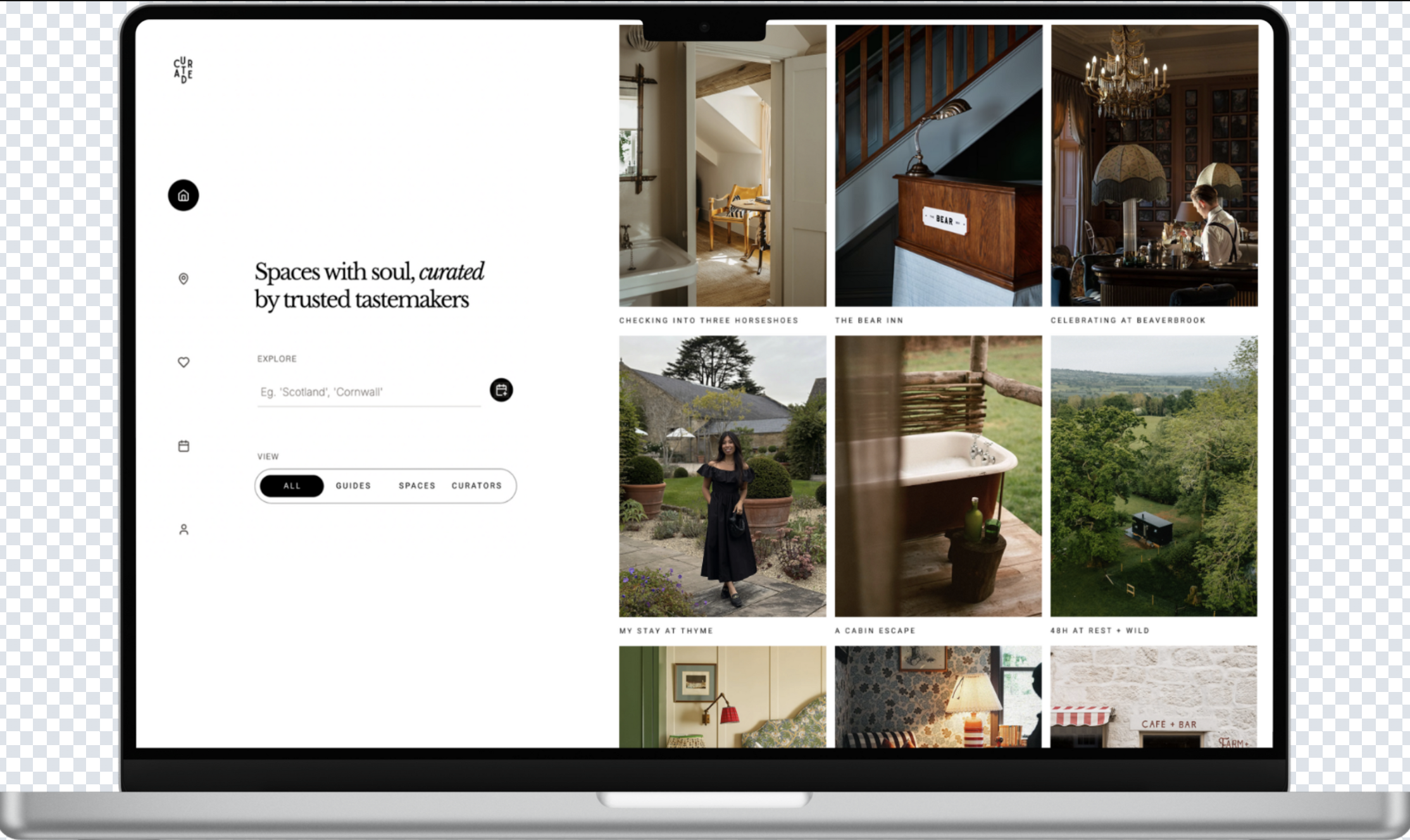
The core belief hasn’t changed - that a recommendation from the right person is worth a thousand anonymous reviews. But what started as a podcast, then a simple discovery platform has grown into something bigger. We realised the stays themselves needed a way to actually work with the creators travellers trust, so we built Curated Studio, an alternative to traditional PR, where a stay can partner with leading voices in travel and culture and build a bank of beautiful, licensed content to use as their own. So we’ve gone from “where do I find the good places” to giving those good places the tools to be found, and to own their story properly.
3. Why is now the right time to expand internationally?
Because the problem we’re solving isn’t a British one and the same thing happens whether you’re saving a farmhouse in Puglia or a cabin in the Highlands. We’ve spent our first months proving the model at home, and now we’ve got a network of creators and stays across the UK and Europe who are ready for it. The appetite for design-led, independent travel is borderless, and frankly the independents abroad are up against the same faceless giants. They deserve a better shopfront too.
4. Has social media and algorithm-driven travel created a culture of sameness?
Completely. We’ve all seen it. the same infinity pool, the same olive grove, the same flat white photographed at the same angle in forty different countries. The algorithm rewards what’s already worked, so it feeds you more of the same, and suddenly everyone’s queuing for the identical photo at the identical viewpoint. It’s made travel weirdly homogenous. The irony is that the most interesting places - the ones with genuine character - often don’t play the algorithm game well at all, so they get buried. Sameness is what you get when a machine optimises for clicks instead of taste.
5. Why are travellers increasingly seeking more meaningful, personal experiences over viral destinations?
I think people are exhausted by the performance of it. There’s a growing sense that the viral thing is often a let-down, you queue, you take the photo, and it’s nothing like the picture. Meanwhile the definition of luxury has completely shifted. It used to be marble and minibars; now it’s slow time, real provenance, a place with a story and a person behind it. People want to feel something, not just photograph something. Once you’ve had the meaningful version, the viral version starts to feel quite hollow.
6. What role does human curation play in travel planning today, and what can it offer that algorithms can’t?
An algorithm can tell you what’s popular. It can’t tell you what’s good. It has no taste, no judgement, no sense of who you are beyond your click history, it’s essentially averaging the crowd. Human curation is the opposite: it’s someone whose eye you trust saying “go here, you’ll love it, and here’s why.” That’s how people have always found the best places - through a friend, a tip, someone in the know. We’re just building the infrastructure for that to happen at scale, and to be saveable and bookable rather than lost in a DM or saved folder.
7. What makes a stay feel “soulful” rather than simply luxurious? And does this resonate with your community?
Luxury can be bought, you can install the same lovely bath and the same high thread count anywhere. Soul can’t. It comes from the people, the place, the particular. A working farm where you collect the eggs. A host who’s poured a decade into getting it right. A building that’s genuinely of its landscape rather than dropped into it. Our partner Fowlescombe Farm is a perfect example, it’s a regenerative farm complete with chickens, cows and veggie patches. And yes, it resonates enormously. Our community isn’t chasing five stars; they’re chasing the feeling of having found somewhere real.
8. How do you see technology and AI changing the way people discover and book travel, and where does human curation become even more valuable?
AI is going to get very good at logistics - the booking, the admin, the “find me a flight at this time.” And that’s genuinely useful. But here’s the thing, the more AI floods the world with generated, averaged, optimised recommendations, the more precious genuine human taste becomes. When everyone can generate a plausible-sounding list of “the ten best hotels in Tuscany,” the thing that stands out is a real person who’s actually been, who has a point of view, who can be trusted. So I think AI raises the value of human curation rather than replacing it. We’re not anti-technology at all, in fact we use it constantly, we’re just very firmly pro-human where it matters. You can’t outsource taste to a machine.
9. What does the next chapter look like for Curated Spaces, and how do you see the platform evolving over the next five years?
The vision is to become the place you go for travel you can actually trust, the antidote to the algorithm. More stays, more brilliant creators, deeper across Europe and beyond. We want every independent stay worth knowing about to have a home on Curated, and every traveller with taste to start their planning with us rather than a search bar. Longer term, it’s about building the whole journey, from the first save to the booking to the next recommendation, around real human trust. If in five years “I found it on Curated” means “I found somewhere genuinely special,” we’ll have done our job.