


Breaking Travel News Investigates: Trend Report from Fitur 2026
BTN brings readers the latest tourism trends directly from the source: industry leaders, innovators, and experts we meet at global events who are shaping the future of travel.
At Fitur 2026,the 46th edition of the global tourism fair in Madrid, the global travel industry arrived with energy, optimism and a clear message. The future of tourism is being shaped by smarter technology, deeper sustainability commitments and a renewed focus on meaningful growth rather than simple volume. From ministers to hotel leaders, from destination marketers to tech innovators, the tone on the show floor was confident and forward looking.
Breaking Travel News spoke to industry leaders, government representatives and experts to understand the trends defining the year ahead. Three themes dominated conversations: the practical rise of AI, sustainability moving from promise to action, and a shift toward more intentional, higher value travel.
Across talks and interviews captured by BTN, three major trends emerged: technology and human-centred innovation, sustainability as a measurable strategy, and meaningful growth driven by connectivity and culture.
Tech and AI: Practical, people-first innovation
.png)
Cemil Hakan Kilic, General Manager of Istanbul Convention and Visitors Bureau (ICVB)
At Fitur this year, technology was everywhere, but the emphasis was on tools that support, not replace, the human side of travel.
Mohamed Moawad, Director General of EgyptAir in Spain and Portugal, spoke about how technology enhances business and passenger experience:
“We have an IT department responsible for new technology… all the airlines in the world are using new technology for… streaming or apps instead of screens, because it reduces cost, it reduces maintenance and improves efficiency,” he told BTN. “Here’s our target for the upcoming years.”
He also shared ambitious network expansion plans:
“We are planning to launch direct flights to Chicago and Los Angeles… and in Africa expand to Benghazi in Libya… and in the Far East like China and India… we are expanding our network to fulfil demand.”
From technology in cabins to flight connectivity, the message was clear: smart tech fuels better, more sustainable travel experiences.
Meanwhile, Cemil Hakan Kilic, General Manager of Istanbul Convention and Visitors Bureau (ICVB), spoke to BTN about innovation on the show floor itself:
“Compared to last year, I believe 119 innovative companies are taking place in 2026-that’s 50% more than 2025. That tells how the demand is rising as the supply is following.” Kilic emphasised that fairs like Fitur help organisations see, learn and apply innovations:
“You can’t sometimes innovate until you see it… this fair is very good in that sense.”
Sustainability: beyond rhetoric into practice
Fitur 2026 made sustainability tangible, with destinations and companies sharing commitments backed by action.
Several interviews highlighted regenerative models, but perhaps none more emphatically than the Creative Tourism Network’s message, shared by its president Caroline Couret:
“By reinventing tourism with existing resources: natural, cultural, human, creative, we can find a regenerated, regenerative model. Creative tourism can be a solution for any kind of destination.”
This phrase ‘regenerated tourism with existing resources’ was among the most powerful reframes heard on the show floor.
For destinations rooted in nature, sustainability is intrinsic. Jesús Eduardo de los Santos Mendoza, Deputy Director of Tourism for Bahia de Banderas in Mexico, explained how surfing tourism creates environmental stewardship:
“I believe surfing could be a motor: economic, touristic, social and environmental. Surfing people are in connection with nature, they bring awareness of nature - most surfers are naturally environmentalists.”
Elsewhere in the Caribbean, leaders celebrated sustainable recovery and resilience. Ministers like Hon. Edmund Bartlett of Jamaica used global stages to reinforce tourism’s environmental and community role, advocating for resilience networks to manage climate and technological disruption.
Tourism in an Era of Permacrisis: Edmund Bartlett on Resilience, AI and Reinventing the Sector
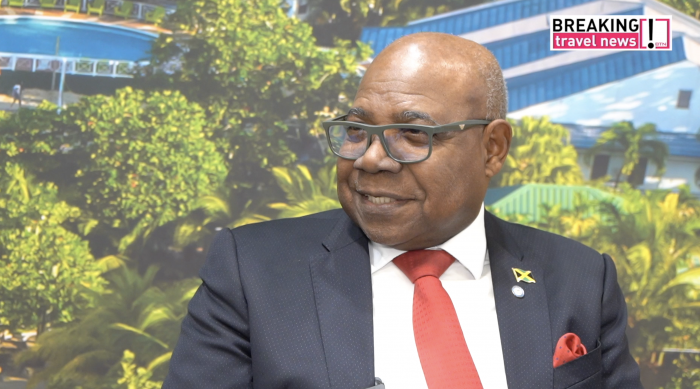
Fitur 2026: Hon. Edmund Bartlett, Minister of Tourism, Jamaica
In an age where destinations face climate change, economic shocks, global misinformation and rapid technological change, Bartlett framed tourism as a field of resilience, recovery and reinvention.
Bartlett did not shy away from confronting harsh realities. Describing 2025’s Hurricane Melissa, he said:
“We had a hurricane, the intensity of which is still to be defined… winds of 185 miles an hour… and gusts of up to 252 miles an hour.”
But what followed was not a narrative of defeat. He detailed the rapid pace of recovery:
“In four weeks after we had all our main infrastructure… And in six weeks we had 90 per cent electricity, water… main road networks intact… We’re going to build back better and we will build back more resilient.”
For Bartlett, resilience in tourism is more than an abstract concept; it’s a practical roadmap for a world increasingly defined by overlapping crises. He explicitly connected climate vulnerability to broader systemic risks, including technological disruption:
“We have an industry that is hugely vulnerable to mega shocks… and we are now seeing a new vulnerability… misinformation and disinformation.”
Bartlett suggested the industry must not only adapt to change but anticipate and shape it. This means new kinds of preparedness, including harnessing technology in ways that protect rather than undermine destinations:
“We could begin a conversation around building resilience in the face of AI and a technology that will have the capability to do great things… but at the same time to destroy your destination.”
His message resonated deeply across Fitur: destinations must balance optimism with realism, creativity with caution, and growth with stewardship. For Bartlett, resilience needs to be strategic rather than reactive, anchored in systems that can withstand shocks while preserving the social and ecological fabric upon which tourism depends.
Connectivity and community as growth engines
Across markets, improved connectivity and community engagement were cited as key drivers of longer, richer stays.
Cemil Hakan Kilic underlined how accessibility makes a difference:
“If the city is reachable… non-connection flights… that helps us a lot… the longer the flight is, the longer they stay… the more they see, the more the walls come down.”
The idea that travel breaks down barriers echoed deeper values of tourism as a connector of cultures.
Mohamed Moawad of EgyptAir shared how Cairo is becoming a global hub. He added that the airline is packaging longer layovers into transit tourism experiences:
“We are organising transit periods from 12 hours to three days… sightseeing in Cairo at the Grand Museum… package food and tours.”
For hotels, creativity and connectivity also matter. Müberra Eresin, President of the Turkish Hotel Association emphasised blending tech with warmth:
“What we do in tourism, we need people… the main thing is hospitality. But we implement technology in the real hospitality sector.”
The message was as much about human touch as digital strategy: technology should be in support of better service, not a substitute for it.
Spain: Leadership at global tourism crossroads

Jordi Hereu Boher, Minister of Industry and Tourism, Spain
As host nation, Spain played a central role at Fitur 2026, with influential speeches and strategic announcements.
Jordi Hereu, Minister of Industry and Tourism, used his presence to highlight Spain’s vision for long-term leadership:
“FITUR has consolidated Spain as the epicentre of global tourism governance… placing Madrid at the heart of industry decision-making.”
Hereu celebrated Spain’s success and future opportunities:
“2025 has been another extraordinary year for tourism in Spain… the deployment of the Tourism Spain 2030 Strategy reinforces the triple sustainability of the sector: social, environmental and economic.”
In Madrid, he also spoke to broader industry goals:
“This agreement with WTTC reinforces the position of Spain as a world tourism powerhouse.”
Data released alongside these remarks confirms Spain’s strength on the world stage: 2025 ended with 97 million foreign tourists, validating its global appeal.
Spain’s approach makes sustainability and quality key pillars while avoiding the pitfalls of unchecked volume:
“We want to maintain international leadership… deconcentrating destinations, diversifying experiences, de-seasonalising, digitalising and redistributing benefits across territories.”
The minister’s comments reflect a nuanced strategy: growth with responsibility, innovation with purpose.
Experiences over numbers: the new tourist mindset
Across interviews, tourism professionals emphasised a shift away from mass visitation toward meaningful, experience-oriented travel.
Guillem Gisbert of Trip.com Group highlighted trend data at Fitur:
“At Fitur, we’re bringing the traveller and partner stories together, helping Spanish travellers plan and manage trips more easily.”
The rise of culture, history, and heritage experiences was also a focus in Fitur’s new FITUR Experience programme, underscoring how travellers increasingly seek deeper engagement with destinations.
Across regions, this trend was mirrored with surfing and marine experiences emphasising connection with nature, the creative tourism initiatives focus on community and intangible heritage, and destinations like Cancun showcasing their social warmth and festivals alongside beaches.
Anna Patricia de la Peña of Cancun summed it up:
“People in Cancun have the best smile… we offer a great experience. People are very welcoming - this is what keeps them coming back.”
These voices from tech and sustainability circles to joyful destination promoters show a sector moving beyond transactional tourism to transformational travel.
Travel awards and recognition: benchmarks of excellence
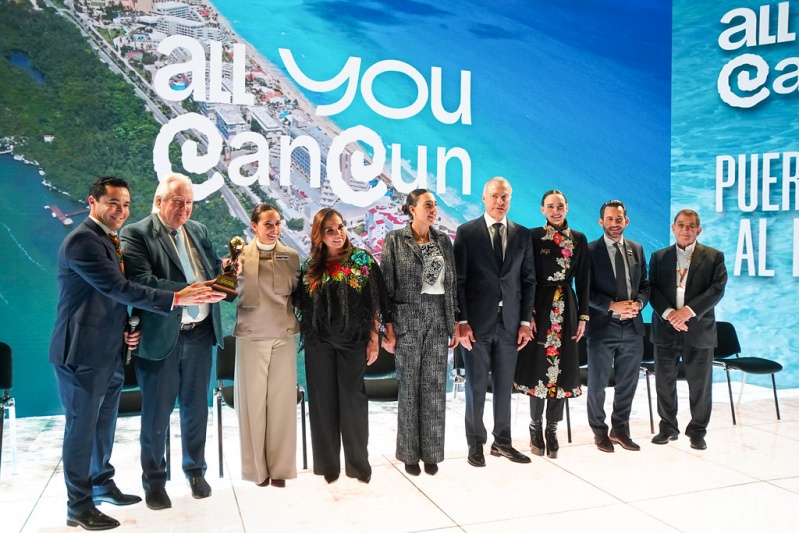
Cancún Convention & Visitors Bureau is presented with the World Travel Award for World’s Leading City Tourist Board at Fitur
Fitur 2026 also highlighted tourism excellence through global awards and recognition.
Cancun, which was a World Travel Award winner and hosted the Latin America ceremony in 2025, used its accolade not just as a badge but as a platform to showcase year-round activities, as Anna Patricia de la Peña, Manager of Cancún’s tourism board put it:
“It was an honour to host this event. These awards are the standard for the tourism world.”
For award-winning destinations and service providers, the narrative at Fitur was clear: recognition accelerates visibility and inspires continued investment in quality and sustainability.
Fitur 2026: Legacy and momentum
The broader context of Fitur 2026 supports the optimism on display. Despite operating in a solemn atmosphere following a national tragedy, the event drew more than 255,000 visitors, boosted international participation and generated a significant economic impact for Madrid. The official opening of Fitur 2026 was presided over by Their Majesties the King and Queen of Spain, underscoring the event’s role as a major global forum for tourism dialogue and cooperation.
At Fitur 2026, tourism demonstrated recovery and resilience through technology, sustainability commitments, strategic cooperation and an unshakeable belief in tourism’s power to connect cultures and enrich lives. Events like this are places where we come together to learn, to innovate and to build a better future for travel.